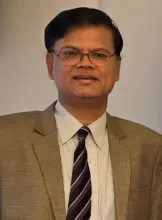
Krishna Vadrevu, Ph.D., serves as Program Manager (On-Detail) for the Land Cover and Land Use Change (LCLUC) Program within the Biosphere portfolio of the Earth Science Division, NASA’s Science Mission Directorate. Following NASA’s recent reorganization of Earth System Science Research and Analysis Program (ESSRP), LCLUC is now positioned within the broader Biosphere framework, strengthening integration across companion Biosphere programs - Biodiversity, Terrestrial Ecosystems, and Ocean Biology and Biodiversity (OBB), while enhancing cross-cutting collaboration throughout NASA’s Earth Science.
Dr. Vadrevu is a Remote Sensing Scientist at NASA’s Earth Science Office, Marshall Space Flight Center, Huntsville, Alabama, where he has been since 2016. During his career, he has served as PI and Co-I on numerous federally funded projects focused on land-use/land-cover change (LCLUC), fires, biomass burning, greenhouse gas emissions, land-atmosphere interactions, and ecosystem sustainability, with over 100 peer-reviewed publications. As a main Editor, he has published 7 books on related topics and has a forthcoming book on Agriculture, Forests and Other Land Use (AFOLU), planned for publication in 2026. He has led 17 journal Special Issues as main Editor and currently serves on the editorial boards of seven journals. Dr. Vadrevu received the 2021 NASA Headquarters Honor Award for Excellence in Achievement in recognition of outstanding, high-impact contributions to implementing exemplary research under the South/Southeast Asia Research Initiative (SARI) of the Land-Cover and Land-Use Change (LCLUC) Program.
As Program Manager, Dr. Vadrevu leads and administers the Biosphere LCLUC element, overseeing its scientific vision, competitive solicitations, funded awards, and overall programmatic activities. He works closely with multiple programs at NASA Headquarters, including Earth System Science Research Program (ESSRP), Earth Action, Data Systems, the Earth Science Technology Office (ESTO), and Flight Programs, ensuring strategic alignment and coordination across research, applications, technology development, and satellite missions. The program also maintains strong coordination with cross-cutting activities such as FireSense, the Commercial Satellite Data Acquisition (CSDA) Program, and Satellite Needs Working Group (SNWG) activities, among others, to advance community data needs and science priorities.
Given the pervasive and widespread impact of land-use change, the program’s focus on pressing regional challenges in the United States and key global areas gives it strong domestic and international reach. LCLUC fosters collaboration among U.S. and international scientists, enhancing regional expertise and advancing understanding of land-use dynamics through innovative NASA Earth observations, modeling, and interdisciplinary research.


