- Urban heat islands (UHIs) in growing cities can have varying degrees of impacts on human health, as well as energy demands for cooling.
- Remote sensing and modeling provide essential information for comprehending and managing urbanization's climate and societal impacts.
- By combining gridded data for temperature, building characteristics, population, and behaviour we are able to model the building energy demand response to UHI
- This demand response can then be used to calculate corresponding changes in power supply and related parameters such as emissions.
How is land cover/use changed?
Urban expansion has been rapid and significant over the last few decades, especially in developing countries where the population is becoming increasingly urban, and where changing land rights and ownership have led to expansion of suburban areas. Its ecological impact is significant and long lasting on the landscape, and the rate of land transformation is at least proportional to population growth and economic development.
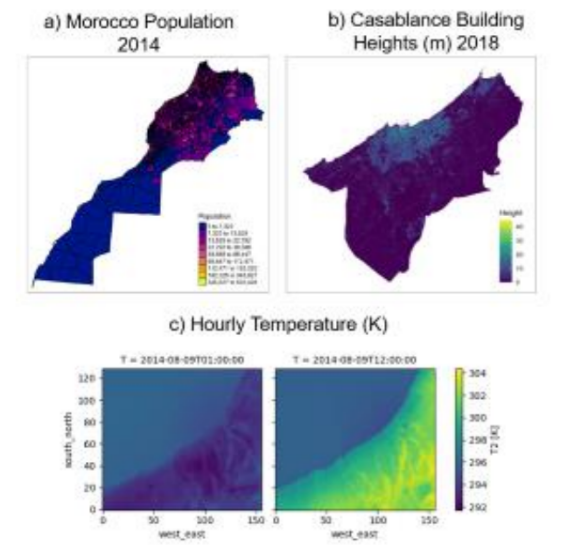
Figure 1: Examples of underlying data to be used for calculating gridded building energy demands. a) Population in Morocco 2014 b) Casablanca Building Heights 2018 c) Hourly Temperature (K)
Why is this Important?
The urban heat island (UHI) effect is a phenomenon where urban areas experience higher temperatures than their surroundings because urban surfaces like concrete and asphalt absorb and retain heat, and buildings block natural cooling processes. The UHI effect is significant as it can lead to increased energy consumption for cooling, health risks from heat-related illnesses, and altered local weather patterns.
How satellite data are being used to inform decision making and Earth Action?
Satellite data plays a pivotal role by providing essential information for mapping urbanization, studying urban heat island effects, assessing regional climate impacts, and analyzing building energy demand, all of which are crucial for addressing the rapid and significant urban expansion happening globally, particularly in developing countries.

Khan, Z. Iyer, G. Patel, P., Kim, S., Hejazi, M., Burleyson, C. & Wise, M. Impacts of long-term temperature change and variability on electricity investments. Nat. Commun., 2021, 12(1), pp. 1-12.
Co-PI: Zarrar Khan, Pacific Northwest National Laboratory, MD, USA; Email: zarrar.khan@pnnl.gov
L. Bounoua (PI) The opinions expressed are solely the PI's and do not reflect NASA's or the US Government's views.