- Urbanization is a leading cause of LCLUC globally, although Africa is currently leading these trends, particularly within small to medium sized, or secondary, cities.
- UN Sustainable Development Goals (SDG) may contribute to global monitoring of urbanization, but methodological gaps limit the consistent application of SDG Indicators.
- We combined remotes sensing products with open-source software to develop automated approaches for delineating urban areas across broad extents and consistently through time.
- Urbanization-driven LCLUC hotspots were identified and further analyzed across Ethiopia, Nigeria, and South Africa.
How is land cover/use classified?
Urbanization continues to be one of the leading drivers of LCLUC globally, although African countries appear to be at
the forefront of these current urban expansion trends. In fact, predictions indicate that there will be more people living in cities in Africa in the next 30 years, than there are people living in cities
right now around the world; with this increase in population growth, it is also expected that we will see a 12-fold increase
in urban land area [1,2].
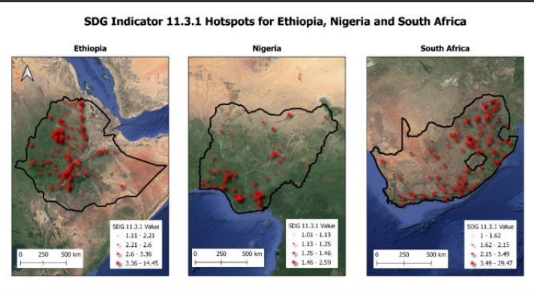
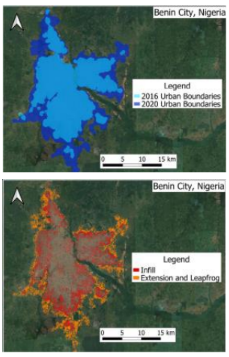
Figure 1: Through our developed remote sensing-based urban delineation and change analyses approaches, we can better monitor rapid urbanization hotspots consistently across broad extents, as well as monitor varying patterns of urban development within hotspots (e.g., infilling and expansion) with implications for LCLUC.
Why is this Important?
Urbanization offers invaluable socio- economic opportunities, but rapid growth can also generate numerous challenges. Consistent monitoring is needed to inform the provision of planning and investment efforts for sustainable development of urban Africa. Current methodological gaps limit the consistent monitoring of urbanization trends across large extents.
How satellite data are being used to inform decision making and Earth Action?
By combining remote sensing derived LCLU products along with open-source software, we can fill methodological gaps to support global urbanization and sustainable development monitoring efforts. Our developed methods provide adaptable urban delineations for consistent tracking of urban change and broader urbanization-driven LCLUC applicable across Africa and other rapidly urbanizing global regions.

[1] Angel et al. 2011, Progress in Planning, 75(2), pp.53-107; [2] United Nations 2017.
https://population.un.org/.
Project Investigator: Dr. Jody Vogeler, Colorado State
University, Colorado, USA; Email: jody.Vogeler@colostate.edu
The opinions expressed are solely the PI's and do not reflect NASA's or the US Government's views.