- Tree-based sinks are the only actions that remove excess carbon now.
- TOF at the scale of individual trees underpin livelihoods of billions of people and lead to more stable incomes under climate-stress conditions.
- NASA earth observations make individual tree carbon measurement counting part of Nature-Based Climate Solutions (NBS); this project mapped every tree in Africa.
- TOF NBS support most international programs, and White House U.S. Net Zero goals.
- Large capital investments are being made in NBS, and TOF solutions increase the relevancy and effectiveness for people’s well being and poverty alleviation.
How is land cover/use classified?
Even while forests are losing carbon and are a source of emissions, there is growing evidence that some landscapes around the world are increasing tree biomass and are important
potential sinks for carbon. The most important hotspots for this phenomenon are systems of trees outside of forests (TOF) in agricultural landscapes in semi-arid zones. Africa and South Asia are particularly important regions, as recent studies have observed farmer-promoted increases in biomass in rural areas. Farmers promote enhanced tree biomass to capture
benefits of ecosystem services provided by agroforestry products and other co-benefits.
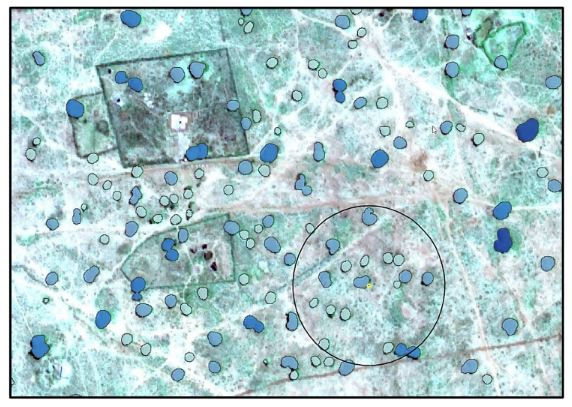
Figure 1: Individual tree crowns detected, mapped and measured for carbon in an AFR100 carbon sequestration project in Kenya. Darker blue is more carbon. Calibration plot shown. These data are mapped for the whole country.
Why is this Important?
This approach maps individual trees at continental scale. This has implications for climate change mitigation and adaptation
actions with new avenues for removals now. In Rwanda more than 70% of trees are TOF, comprising half of the national carbon, heretofore undocumented. Across all of Africa more than 25% of tree cover is outside of areas of forest. Bringing TOF into climate policy actions benefits well being and incomes of billions of people.
How satellite data are being used to inform decision making and Earth Action?
Measurements of individual trees are made with very-high-resolution (<1 m) remote sensing over continental areas. Deep machine learning uses artificial intelligence models of tree features to map individual tree crowns over millions of square kilometers. Tree carbon is estimated with allometric scaling models of crowns maps, calibrated with field data. Removals are made from change maps.

Skole et al. 2021. Trees outside of forests as natural climate solutions. Nature Climate Change 11:1006-10016
Project Investigator: David L. Skole, Michigan State University, MI, USA, skole@msu.edu
The opinions expressed are solely the PI's and do not reflect NASA's or the US Government's views.