Land Use Science in Action

ENABLING HARM REDUCTION FROM EXTREME HEAT IN A WARMING CLIMATE
- The Arabian Peninsula already suffers from the most extreme heat on the planet.
- Climate Chance and Land-Cover and Land-Use Change are amplifying extreme heat across the Arabian Peninsula, impacting human health.
- Fusing remote-sensed LCLUC and climate data with weather models can improve extreme heat forecasting and climate projections.
- NASA’s Earth Observation platforms can enable the operationalization of monitoring and forecasting of extreme heat and guide adaptations to reduce harm to improve health.
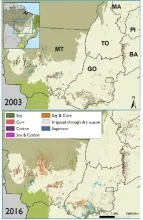
Characterizing land-use transitions helps combat climate change impacts and informs land-use policy
- The most biologically diverse savanna on earth is a major frontier of LCLUC
- It is yet unknown where high-impact land-use transitions are concentrated and the main drivers of those changes
- Urgent need to develop detection methods and novel data sets to inform decision-making a to address biodiversity loss and mitigate climate change impacts
- Use of Earth Observation data, time series analyses, and machine learning algorithms to expand the spatial and temporal data on agricultural development and a novel data set on irrigated agriculture in combination with spatial analyses of socioeconomic influences

DIFFERENT APPROACH TO U.S. DRUG POLICY NEEDED TO MEET CONSERVATION GOALS
- Counterdrug interdiction pushes cocaine trafficking into biodiverse landscapes.
- Analyses integrating remote sensing and socioeconomic data can identify and quantify land use/cover-change caused by illicit economies.
- Urgent need for such analyses to inform action to mitigate climate change and biodiversity loss in Central America.
- NASA’s role in Earth observation is essential for evaluating long-running U.S. policies.
- Long-term effects of U.S. drug policy undermine international conservation efforts.