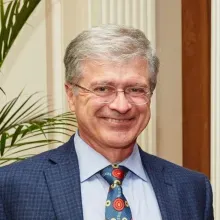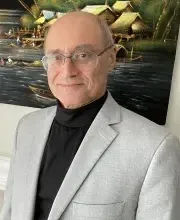
Dr. Garik Gutman, recently retired Program Manager of the NASA Land-Cover/Land-Use Change (LCLUC) Program, received his Ph.D. in Climate Modeling in 1984. In the late 1980s, he was a National Research Council Fellow of the National Academy of Sciences at the National Oceanic and Atmospheric Administration (NOAA) and then a NOAA civil servant. He conducted research at NOAA for 14 years focused on satellite remote sensing of the Earth’s land surface and atmosphere, mostly using global observations from the Advanced Very High-Resolution Radiometer (AVHRR). During the mid-1990s, Dr. Gutman played an active role in developing the Pathfinder global land time-series dataset from AVHRR. In 1996, for developing an original technique using satellite data for reliable analyses of the Earth’s vegetation cover and its long-term variations, Dr. Gutman received the U.S. Department of Commerce Bronze Medal Award. He joined NASA in 1999 as the Land-Cover/Land-Use Change Program Manager at NASA Headquarters and led this program, as well as Landsat-related activities at NASA, until his retirement.
Over the past 25 years, in his position at NASA Headquarters, Dr. Gutman served as Program Scientist for the NASA EO-1, Landsat, and Terra missions. At the national level, he chaired the U.S. Global Change Research Program (USGCRP) Land-Use/Land-Cover Change Working Group for two years. He collaborated with the United States Geological Survey (USGS) on Landsat-related activities and co-led the NASA–USGS Global Land Survey initiative, which was directed at developing global land mosaics every five years at Landsat spatial (30 m) resolution, before Landsat data became available free of charge. During the past 12 years, Dr. Gutman led the NASA Multi-Source Land Imaging (MuSLI) program, consisting of LCLUC projects based on the synergistic use of Landsat and ESA’s Sentinel-1 and Sentinel-2 observations. In collaboration with NASA’s Goddard Space Flight Center (GSFC) and the University of Maryland, Dr. Gutman initiated the development of the Harmonized Landsat–Sentinel-2 (HLS) reflectance dataset. His research interests included the use of remote sensing at moderate (20–30 m), high (10 m), and very high (1–5 m) spatial resolutions for detecting changes in land cover and land use, and for analyzing the impacts of these changes on climate, the environment, and society. In 2020, Dr. Gutman led the NASA Pilot Project assessing the value of very high-resolution commercial data for NASA research and applications. The most recent emphasis of the LCLUC program has been the identification of land-use hotspots across the globe and the incorporation of land-use remote sensing datasets and processes into numerical weather forecast and climate models, toward the development of Earth System Digital Twins. In 2023, he was awarded the NASA Exceptional Service Medal.
Educational and capacity-building activities have been an important part of the LCLUC program. Each regional Science Team meeting has included an adjacent training activity for local early-career scientists and students. Over the past 15 years, Dr. Gutman co-led, with his ESA counterpart, a “Trans-Atlantic Training” program aimed at building capacity among regional students across Central, Eastern, and Southern Europe, in conjunction with the Northern Eurasia Earth Science Partnership Initiative (NEESPI). Similarly, during the past decade, capacity-building activities were regularly conducted in Asia within the framework of the South/Southeast Asia Research Initiative (SARI). As an Ambassador of Science under a U.S. State Department program, Dr. Gutman lectured at several institutions in Hungary, Romania, and Serbia in 2023. He also gave a short course on land remote sensing virtually to teachers and teenage students from various schools in Estonia and to first-year students at the University of Çanakkale, Turkey. Dr. Gutman made in-person presentations to school students in Cyprus and Algeria while attending scientific meetings there, as well as to university students at Fudan University Summer School in Shanghai, China.
The LCLUC research program helps develop underpinning science and promotes international scientific cooperation by supporting the development of regional science networks worldwide under the Global Observations of Forest Cover and Land-use Dynamics (GOFC-GOLD) international program, of which Dr. Gutman was a major sponsor and supporter for three decades. Dr. Gutman played a key role in building large, multi-agency international programs in Northern Eurasia (NEESPI) and in Monsoon Asia (MAIRS), both under the International Geosphere–Biosphere Programme (IGBP) and the World Climate Research Programme (WCRP). In South America, the LCLUC Program supported the Large-Scale Biosphere–Atmosphere Experiment in Amazonia (LBA). In South and Southeast Asia, Dr. Gutman initiated and supported the NASA SARI program. Programmatically, he represented NASA in Committee on Earth Observation Satellites (CEOS) Working Groups. He is a member of the American Geophysical Union (AGU) and Sub-commission A of the Committee on Space Research (COSPAR). In 2010, for his international activities Dr. Gutman received the NASA Cooperative External Achievement Award.
Dr. Gutman is the author of more than 90 publications in peer-reviewed scientific journals and several chapters in climate- and land-cover-related scientific books. He served as Chief Editor of the compiled volume Land Change Science, published in 2004, which was based on results from projects supported by the NASA LCLUC Program during its first eight years. He has also been a lead editor or co-editor of several books on LCLUC–climate interactions published by Springer, focusing on the Eurasian Arctic, Siberia, Eastern Europe, and Central Asia. Dr. Gutman served as an Editorial Board member for two open-access MDPI journals, Remote Sensing and Land. He also served on advisory boards for several European projects.