• Developed Noah-MP HUE —the first urban land surface model with sub-grid lateral water transfer and GI heterogeneity
• Urban vegetation in Milwaukee reduced simulated land surface temperatures by 5–15% in heavily impervious areas
• Nocturnal urban heat island reduced by ~2% and precipitation patterns improved vs. in-situ observations
• Large-scale greening reduces summer runoff and lowers daytime heat index on extreme heat days (≥90°F)
• Noah-MP HUE is coupled with WRF, enabling city-scale digital twin simulations of GI adaptation scenarios
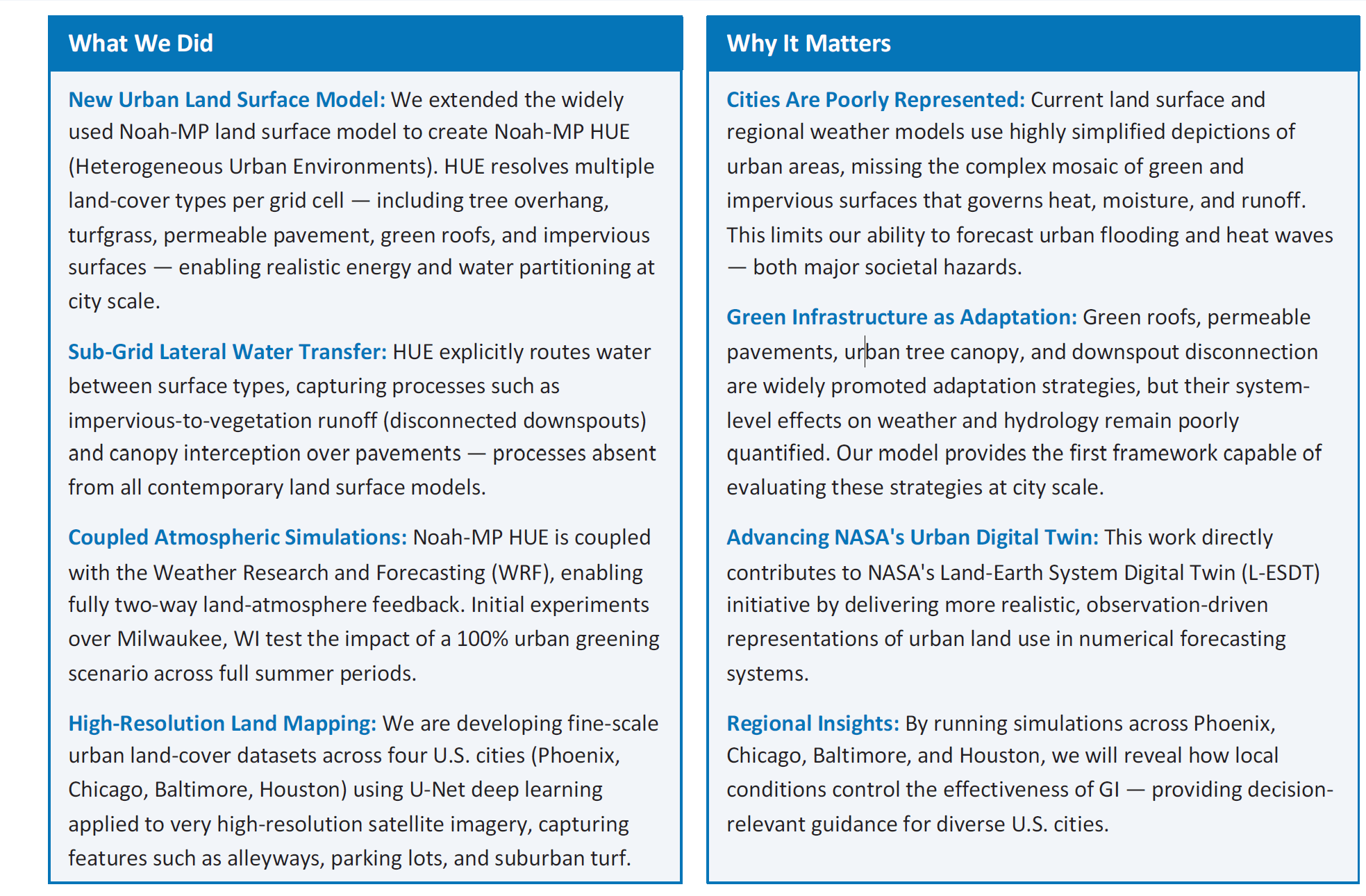
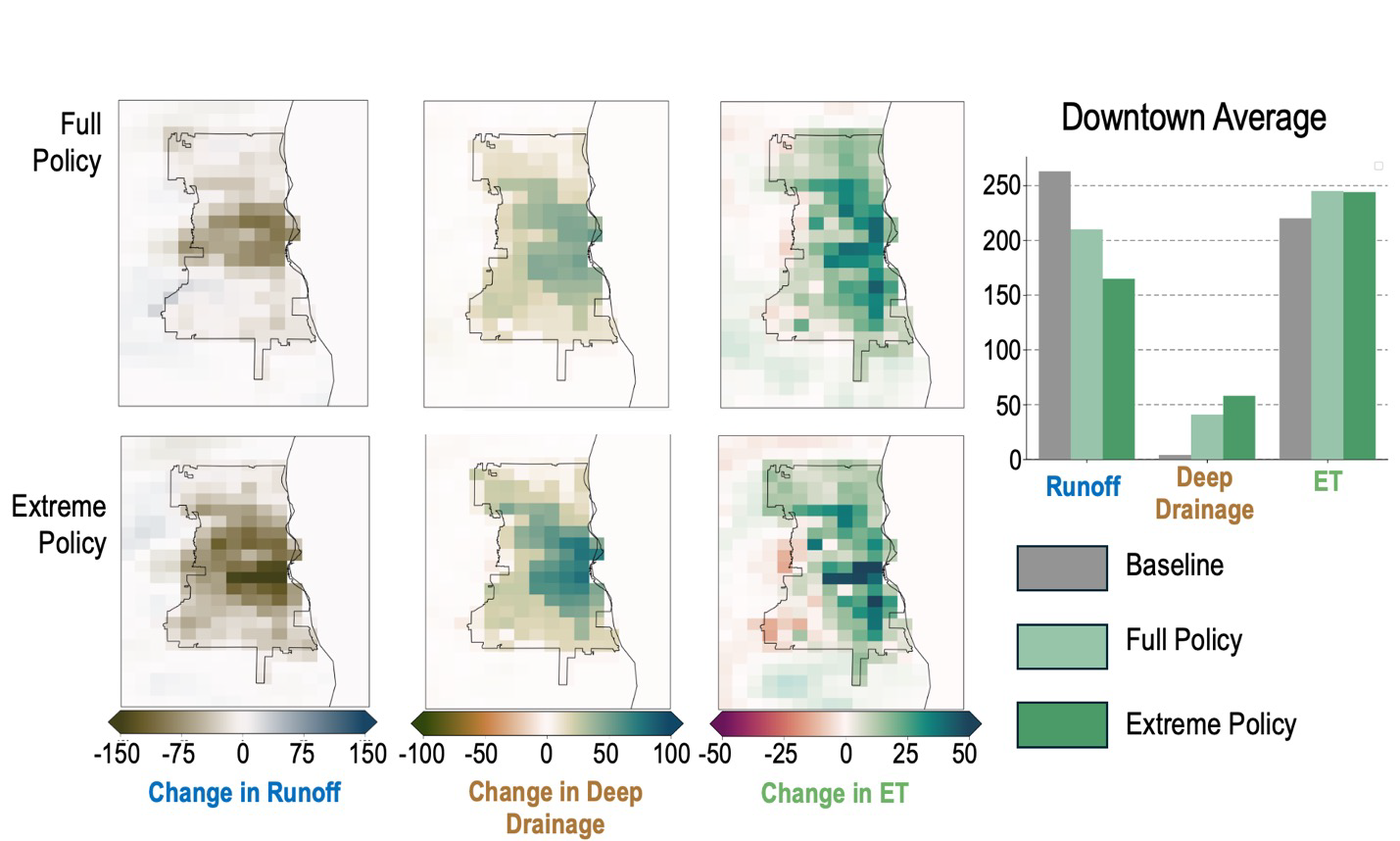
Figure 1: Changes in summertime runoff, deep drainage, and evapotranspiration differences over the entire Milwaukee region under different greening scenarios. Full policy refers to integrating the full Green infrastructure plan, while the Extreme Policy refers to 150% of the Green Infrastructure plan. Bar plots show the average changes in the Downtown area Milwaukee.
Publication: Alexander G. A., et al (2025): Modeling Future Heat Extremes in Milwaukee Wisconsin Using Extremes-Preserving Psuedo-Global Warming Methods. Session: H31 Hydrometeorologic Extremes: Prediction, Simulation, and Change III Oral. New Orleans, Louisiana. Presented at the American Geophysical Union Fall Meeting 2025.
Project Investigator: Mutlu Ozdogan, Associate Professor, Nelson Institute SAGE, University of Wisconsin-Madison | ozdogan@wisc.edu
Co-Is: Daniel Wright & Annemarie Schneider (UW-Madison)