
Impact of Urbanization on the Continental US Surface Climate

US cities are home to more than 50% of the population and this is where climate change will be felt the most. Urban communities will be interested to know how cities interact with climate and the scientific community is interested to include the urban ecosystem functions in climate models. Scientists at NASA use data fusion from Landsat and MODIS to characterize US urbanization and model its impact on surface climate. For cities built within forests, daytime urban land surface temperature (LST) is found to be higher than that of vegetated lands.
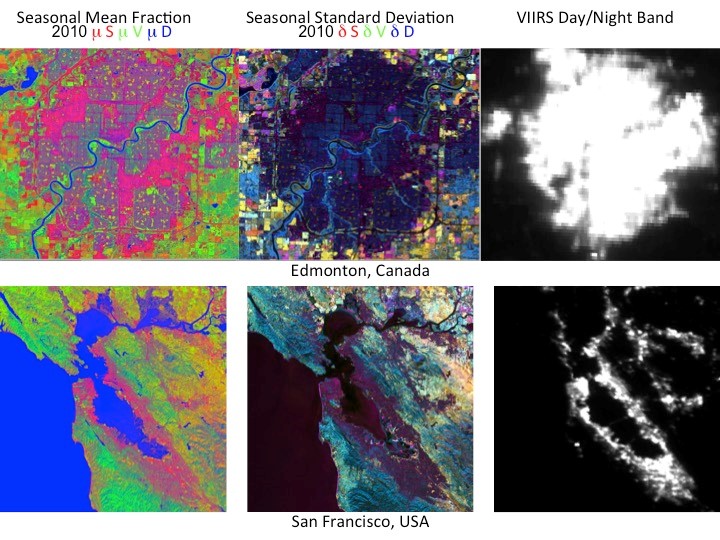
Mapping Urban Expansion Using Multi-Decadal Landsat And Nightlights Data Over North America

Urbanization is among the most rapid and visible types of landscape transformations with climatic, hydrological, biophysical and ecological impacts on the environment. To quantify the impacts of such transformation urban areas should be characterized in terms of both the density of impervious areas and vegetated cover. In this project we use observations from Landsat and NPOESS VIIRS Day/Night Band to derive a consistent, robust, scalable characterization of the urbanization at sub-pixel resolutions.

U.S. and ESA sign Sentinel data accesss agreements

U.S. and ESA sign Sentinel data accesss agreements

ESA has agreed with NASA, the National Oceanic and Atmospheric Administration (NOAA) and the US Geological Survey (USGS) to make data available to them from the European Sentinel satellites. With the third Copernicus satellite, Sentinel-3A, recently launched, ESA has signed technical arrangements with these US agencies for accessing Sentinel data. These arrangements coordinate the technical implementation covering the Sentinel data access to the US.

LCLUC e newsletter Issue 2

LCLUC e newsletter Issue 2

The NASA LCLUC Program continues to chart new waters in different parts of the World. The South and South-east Asia Research Initiative (SARI) was presented to and endorsed by NASA senior management at the end of last year and was formally launched at the Regional LCLUC Science Team Meeting in Yangon, Myanmar, in January. The meeting introduced many new regional scientists to the program and how to access and use NASA data through hands-on training.

CDC webinar: Introduction to Admin Boundary Maps of China: 1949-2014

CDC webinar: Introduction to Admin Boundary Maps of China: 1949-2014

This workshop will introduce “Administrative Boundary Maps of China: 1949-2014” distributed by the University of Michigan China Data Center. In a collaboration with the Chinese Academy of Sciences, the UM China Data Center has recently released a new GIS data product: “Administrative Boundary Maps of China: 1949-2014”, which includes a series of administrative boundary maps at province, prefecture city and county levels from 1949 to 2014. The data is distributed in GIS shape files with both Chinese and English.